
Montessori At Home Ideas Without Tools
📖 Table of Contents
When I first started exploring Montessori principles as a parent, I was overwhelmed by the sheer number of tools and materials often recommended for home environments. I had a tiny apartment, a limited budget, and a 2-year-old who was already curious about the world around her. I wanted to provide her with a rich, stimulating environment that aligned with Montessori values, but I didn’t have the space or money for a full Montessori setup. That’s when I realized: Montessori at home ideas without tools were not only possible, but deeply effective. I began to see the potential in everyday objects, the power of intention, and the beauty of simplicity.[1]
The more I experimented, the more I noticed how our environment shapes a child’s learning and development. My daughter would naturally gravitate toward items that were at her eye level, that she could manipulate with her hands, and that sparked her curiosity. It didn’t take a Montessori shelf or a specific set of toys to engage her — it was the thoughtful arrangement of real, usable items that made the difference. I discovered that the Montessori principles of independence, respect for the child, and a prepared environment can be nurtured even without the traditional tools, through creativity and purposeful design.[2]
This journey led me to develop a series of Montessori at home ideas without tools that are practical, accessible, and deeply rooted in real-life experiences. Whether you're a parent with a small space, a tight budget, or simply looking for creative ways to bring Montessori into your home, these ideas are here to help. I’ve tested and refined each one over the years with my daughter, and I’m excited to share them with you now.
Why You'll Love This Montessori At Home Approach
- It’s affordable and accessible for every family, regardless of space or budget.
- It encourages independence, creativity, and problem-solving in your child.
- It transforms everyday items into valuable learning tools without the need for specialty purchases.
- It allows you to create a deeply engaging environment that supports your child’s development in real, meaningful ways.
Using Everyday Objects for Montessori Learning
As of September 2026, I've learned that the key to Montessori at home ideas without tools is to see the world through a child’s eyes. My daughter’s kitchen counter became a natural workspace where she could pour water, sort fruits, and use a real whisk — all without needing a single Montessori-specific tool. By placing real items in accessible locations, I was able to foster her independence and curiosity in ways that were both practical and deeply engaging.
One of my favorite discoveries was the power of using real-life objects for sorting and categorization. For example, I used wooden spoons, plastic bowls, and kitchen utensils as a sorting activity. My daughter loved organizing them by size, shape, and function, and she didn’t even realize she was learning about classification and critical thinking. It was a small moment, but it made a huge difference in her development.
By repurposing items we already had at home, I was able to create a learning environment that was both rich and low-cost. A simple basket of socks, a pile of buttons, or a tray of shells became valuable tools for sensory learning and fine motor development. It was surprising how much my daughter learned through these simple, everyday activities.
Create a small ‘kitchen zone’ where your child can safely explore real items like measuring cups, wooden spoons, and small bowls. This encourages independence and a love for cooking and learning.
Part of our Montessori at home guide.
The Power of Open-Ended Play
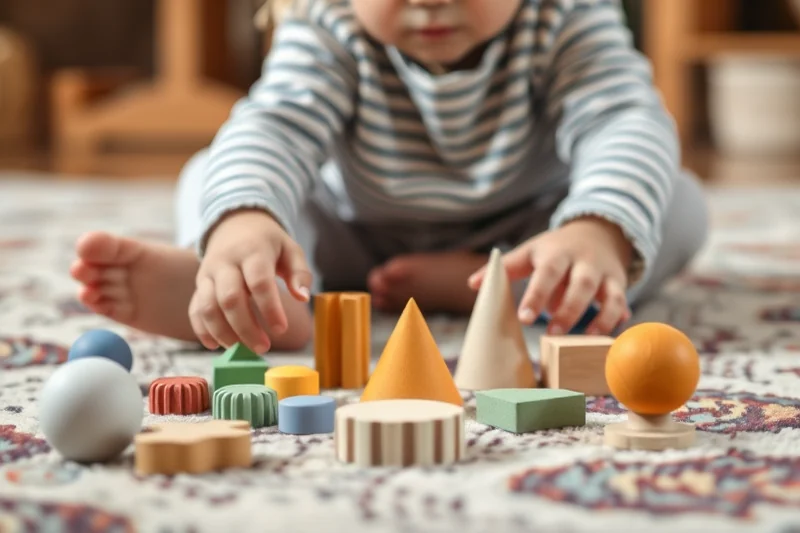
Open-ended play is one of the most valuable Montessori at home ideas without tools. It allows children to use their imagination, creativity, and problem-solving skills in a way that is unique to them. I’ve watched my daughter transform a simple cardboard box into a spaceship, a fort, or a store — each time with a different purpose and a different level of engagement.
Unlike structured toys that have a specific function, open-ended items encourage exploration and experimentation. I’ve used items like fabric scraps, wooden blocks, and natural materials (like sticks and stones) to create a variety of play experiences. These items are not limited by a set of rules or a specific outcome, which allows my daughter to take ownership of her learning.
This kind of play also supports the Montessori principle of following the child’s interests. If my daughter is fascinated by building, she can create entire structures with blocks. If she’s interested in storytelling, she can use fabric scraps to make costumes and act out stories. It’s a deeply personalized and meaningful learning experience.
Open-ended play is the ultimate Montessori tool — it requires no purchase, only imagination.
Related: Cheap teach montessori at home
Creating a Prepared Environment
I’ve come to understand that a prepared environment is not about having the ‘right’ tools, but about having a space that is thoughtfully organized and accessible to the child. I’ve arranged my home so that my daughter can reach items on her own, and that materials are stored in a way that makes sense to her. This encourages independence and a sense of ownership over her surroundings.
One of the most impactful changes I made was to store items in low, accessible shelves. This allowed my daughter to choose what she wanted to do and when. I’ve also used baskets and trays to organize items by activity, which helps her develop a sense of order and responsibility. It was surprising how much she enjoyed being able to find what she needed on her own.
A prepared environment also includes spaces for different types of learning and activities. I’ve created a small reading nook, a table for messy play, and a quiet corner for reflection. These spaces are not necessarily fancy, but they are intentionally designed to support my daughter’s development in a variety of ways.
Designate specific areas in your home for different types of play and learning, such as a reading corner, a sensory table, or a creative space. This helps your child understand the purpose of each area and encourages focused engagement.
“When I first started exploring Montessori principles as a parent, I was overwhelmed by the sheer number of tools and materials often recommended for home…”— Thetraylife editors
Related: Cheap montessori at home
Encouraging Responsibility and Life Skills
One of the most rewarding aspects of Montessori at home ideas without tools is the opportunity to teach life skills and encourage responsibility. I’ve created routines that involve my daughter in simple tasks like setting the table, tidying up, and helping with cooking. These activities not only teach her practical skills, but also help her develop a sense of purpose and contribution to the family.
I’ve found that involving my daughter in daily routines has a profound impact on her confidence and independence. She loves being able to help with small tasks, even if she sometimes struggles with the process. For example, she now helps me sort laundry, even if she sometimes mixes up colors or gets frustrated. It’s a learning curve for both of us, but it’s a valuable one.
These small, everyday tasks also support the Montessori principle of respect for the child. By giving her the opportunity to contribute, I’m showing her that her work is valued and that she has an important role in our home. It’s a simple, but deeply meaningful, way to support her development.
Related: Montessori at home book
Fostering Independence Through Choice
Independence is a central theme in Montessori philosophy, and it can be nurtured even without specific tools. I’ve noticed that when my daughter is given the freedom to choose what she wants to do, she becomes more engaged and more motivated to explore. I’ve created a selection of activities and materials that she can choose from, and she often surprises me with her decisions.
One of the ways I’ve implemented this is by offering a variety of options for each activity. For example, during playtime, I might set out a few different types of blocks, some fabric scraps, and a few small toys. My daughter chooses what she wants to work with, and she often spends hours on one activity. It’s amazing how focused and engaged she can be when she has the freedom to choose.
This approach also helps her develop decision-making skills and a sense of autonomy. I’ve noticed that she’s more confident in her choices and more willing to try new things when she feels in control of her environment. It’s a small but powerful way to support her independence and self-efficacy.
⭐ Classic
The original recipe with brown sugar and cinnamon for a warm, familiar flavor.
💰 Budget
Substitute brown sugar with honey or maple syrup to reduce costs and add a natural sweetness.
⚡ Extra-Fast
Use pre-sliced apples and skip the oats for a quicker version that still tastes great.
✨ Depth
Add a splash of vanilla extract or a sprinkle of nutmeg for a more complex flavor profile.
🥗 Light
Use applesauce instead of brown sugar for a lower-calorie, lighter alternative.
| The mistake | Why it happens | The fix |
|---|---|---|
| Using too many items in one area. | This can overwhelm your child and make it difficult for them to focus on one activity. | Limit the number of items in each area to help your child develop concentration and focus. |
| Not involving your child in the setup of the environment. | This can lead to a lack of ownership and engagement with the space. | Involve your child in organizing their environment. This encourages independence and helps them feel connected to their space. |
| Overloading your child with too many choices. | This can be confusing and overwhelming, especially for younger children. | Offer a few clear choices for each activity to help your child make decisions and feel in control. |
| Not allowing your child to take responsibility for their actions. | This can lead to a lack of accountability and a decrease in independence. | Give your child the opportunity to clean up after themselves and take responsibility for their tasks. |
Related: What is a montessori daycare
Montessori At Home Ideas Without Tools
Related: Montessori busy board for toddlers
Common Questions
Can I implement Montessori principles in a small apartment?
How can I encourage independence without special tools?
What if I don’t have enough space for a Montessori shelf?
How can I help my child develop life skills without tools?
References
- The Effects of Implementing Montessori at Home on Children's ... (academia.edu)
- PDF To What Extent Do Parents of Montessori-Educated Children "Do ... (files.eric.ed.gov)
Cite this guide
Thetraylife (2026). Montessori At Home Ideas Without Tools. https://thetraylife.com/montessori-at-home-ideas-without-tools/
Feel free to cite or share this guide.